Outreach & News
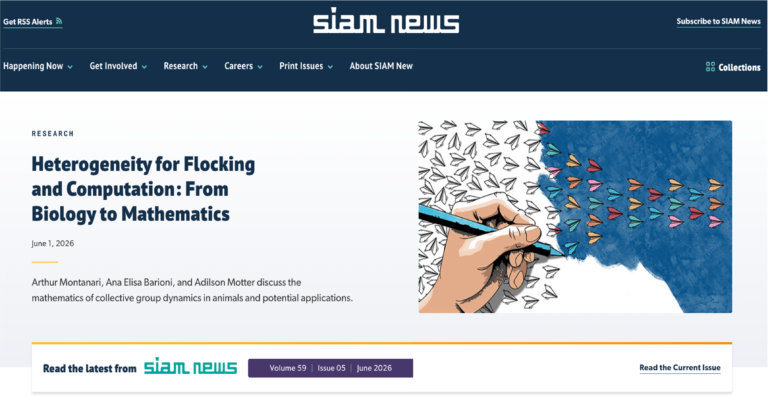
SIAM News on Flocking and Computation
This SIAM News article discusses the mathematics of collective group dynamics in animals and engineering applications. The article is inspired by recent research on the role of agent heterogeneity in flocking, including our recent Nature Communications paper.
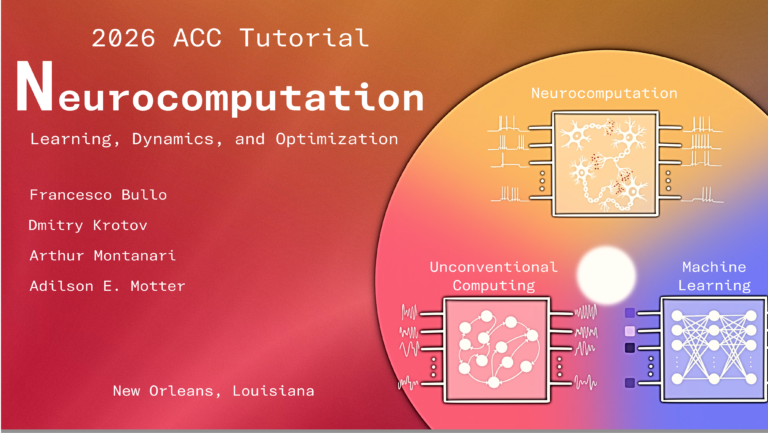
ACC Tutorial on Neurocomputation: Learning, Dynamics, and Optimization
Recent advances at the intersection of control theory and neuroscience have revealed novel mechanisms by which dynamical systems perform computation. This tutorial, to be presented at American Control Conference 2026, will explore a wide range of conceptual and computational ideas, including model learning and training, memory retrieval, data-driven control, and optimization. The tutorial paper is available on arXiv.
May 27th, 2026 (3:30 to 5:00 pm). Learn more.
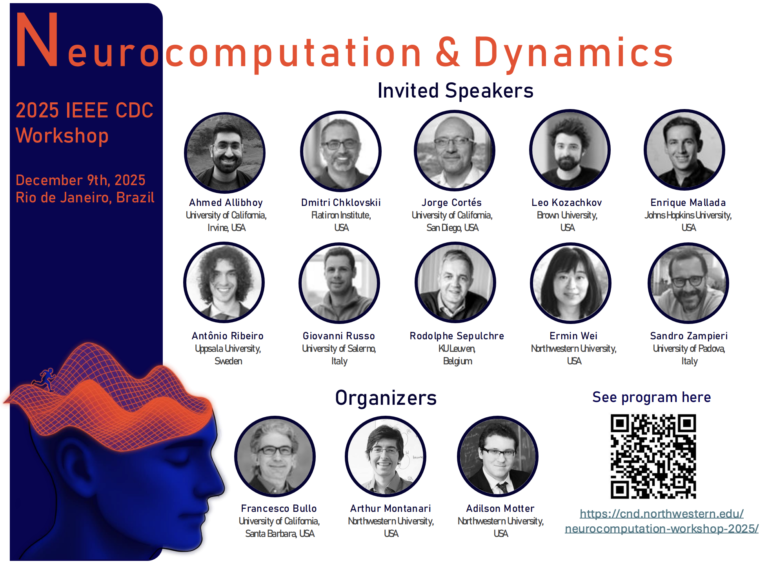
Neurocomputation and Dynamics Workshop at the 2025 IEEE CDC
Join us at the Neurocomputation and Dynamics Workshop, to be held as part of the 2025 IEEE Conference on Decision and Control in Rio de Janeiro, Brazil! The event will bring together experts to discuss computation in natural systems and brain-inspired approaches in artificial systems. The workshop is designed to be accessible to a broad CDC audience not yet familiar with neuroscience or bio-inspired computing.
December 9th, 2025 (8:30 am to 6:00 pm).
Slides available here.
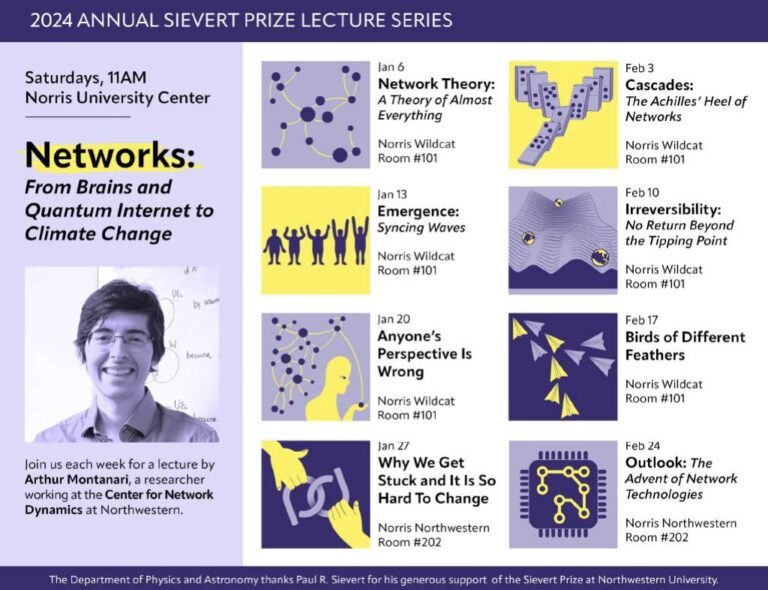
2024 Annual Sievert Prize Lectures
Networks are everywhere. In nature, they regulate food webs, brain activity, and cellular processes. In engineering, they deliver energy and water, mediate traffic, and disseminate information. In society, they govern financial, social, and environmental dynamics. We explore the theory describing the science of interactions and its power to address disparate systems.
In Winter 2024, I was honored to receive the Sievert Lecture Prize from the Department of Physics and Astronomy at Northwestern. I presented a series of 8 one-hour lectures designed for the general public in Evanston, IL, including graduate and undergraduate students, faculty from various disciplines, high-school students, and retirees.
To see the recordings, check the Youtube playlist here.